Origin of Cream Ringnecks, Stubby Dwarf Ringnecks, Pink Ringnecks, Silky Breeding Data, Sex Linked Colors in Ringnecks , Genotypes phenotypes
A RECESSIVE
MUTANT "STUBBY DWARF" IN RINGNECK DOVES
by
Wilmer
J. Miller
One of the aggravating and frustrating facets of research is the unplanned sudden discovery that you follow up for years but it doesn’t quite pan out. Stubby dwarfs, as Dr. Hollander named them, turned up. They had general skeletal reduction , shortened wings, legs, and toes and looked "scrawny" as squabs. Most got mashed or died early as squabs, but some grew up. To start at the beginning was the beginning of my doves.
My original pair of doves were whites and came from L. M. Manguno, New Orleans in 1939. They were on the small side, but nice birds. In 1944 I obtained 2 white females from P. P. Kneupr, New Braunfels, Texas and a pair of whites from J. W. Steinbeck, Concord, California. (To round out my sources story, I also obtained the blond ringneck type from A. R. Andrews, Augusta, Georgia in 1945, but they have nothing to do with this story.)
One of the offspring of the New Orleans doves was a hook bill--the end of the top mandible curved sharply down like that of a hawk. Four more generations including two outcrosses to the Texas and California female contained one or more hook bills (all on the small side) each generation. The fifth generation skipped the hook bill phenotype, but the sixth turned up a corker! This hook bill was a very small male and "swaybacked". My mother had raised it at home while I was in the University, Junior year. She said its back was not completely closed at hatching, but it lived. I kept his line going right into some of the research doves at the University of Wisconsin, then the University of California, and then Iowa State University.
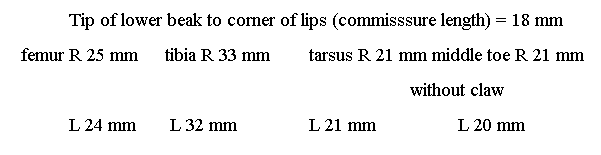
I had shipped some doves to Dr. Hollander related to some very small doves I had. Some of the doves he raised he called dwarfs, and so I felt I could call mine dwarfs too. The only measurements available on these dwarfs is that he sent on 26 Nov 60 on a 4 month old female dark silky accidentally killed by a chicken:
I had one beautiful pair of dwarfs well matched: 1F, the male at 140 grams, and 8Q, the female at 120 grams. Their first squab, evidently a dwarf, was just banded and I was at work when a boxer dog was sicked on them by an 8 year old boy. That dog tore the 3’x 3’x 4’ chicken wire pens to pieces and killed all 3 before my wife could get outside.
The dwarfs turned up sporadically here at ISU in my stock although the hook bill character only occurred sporadically in other lines. Dr. Hollander made alizarin skeletal stained preparations of two of them and I obtained family data. The stained examples disappeared and the only mensurate data I have are weight records and bill lengths. The commissure length is usually 20-21 mm in most ringnecks but tends to be about 18 in dwarfs. Probably more important is the weight. I take weights on nearly all my doves at 6 months of age. Later weight gains are small, usually not over 20 grams more. I haven’t worked up yet the average weight and standard error but 160 grams is about the usual weight of a ringneck dove. They can get to be over 210 grams. The dwarfs were 140 grams (118, 120, 120, 123, 124, 128, 130, 140’s) or under with one possible exception which was 150 grams.
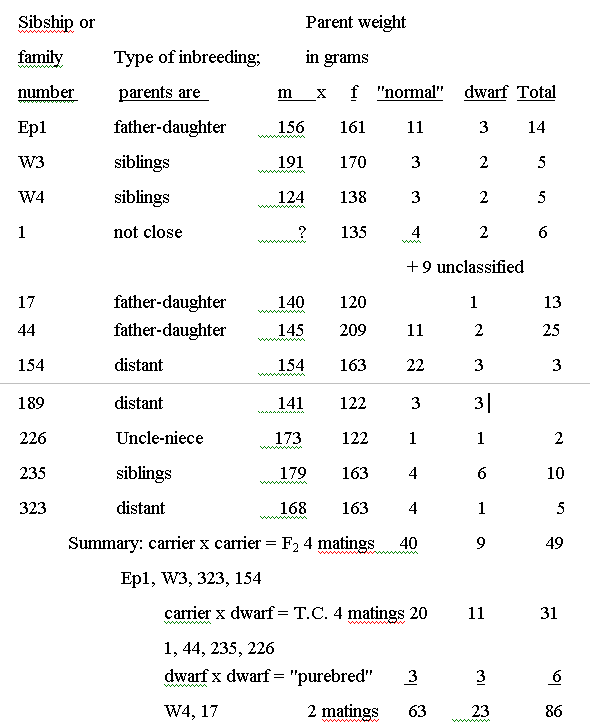
In my pre-ISU data there were 7 dwarfs. One inbred sibling pair of dwarfs produced 5 offspring, two classifiable as dwarfs. A father-daughter pair produced 3 dwarfs out of 14 offspring. Another sibling pair included swayback (124 g.), and produced two dwarfs of 5 offspring classified.
The California and ISU data combined show 16 classified dwarfs of which 5 became adults. Two closely related dwarfs were killed by that dog I mentioned. Two more I outcrossed, yielding 5 normal progeny, and the fifth I mated to a normal brother (as well as making two outcrosses). That sib mating yielded 6 dwarfs and 4 normals.
The data is consistent with the inheritance pattern of a genetic recessive with 50-70% penetrance and variable expressvity! That is, it is not really satisfactory. It is a detrimental character since most stubby dwarfs die in the first few days or weeks of life. The early association of dwarf and hook bill seemed not to hold up in later generations. The administrative dictum of "Cut down" put fini to the type, since the few birds saved to maintain the type didn’t. I did give away probable carriers-- to Dan Dorney for one. May be your stock will show some day.
Table 1. Family data of dwarf ring necks.
Origin of Cream Ringnecks, Stubby Dwarf Ringnecks, Pink Ringnecks, Silky Breeding Data, Sex Linked Colors in Ringnecks , Genotypes phenotypes